Tuesday, November 3, 2015

Ruminations of Aswatthama

As Aswatthama wanders, he recalls his memory as thus:


One life
Adding up second to second
Minute to minute, day to day
Blankness before
Blankness behind
Millions of moments to go
Billions of blisters to bear
Trillions of timeless experiences behind
Confusion in the hind
Commotion in the mind
Lots to rewind
People harsh and kind
Mind, speech, and actions blind

Blinded by sins, blinded by deeds
Weeds of sins among gardens of good
What is left to see, to hear?
What is left to speak, to do?
What bad is left?
What good is right?
A day of light
A night of darkness
I’ve seen nights of light
And days of darkness
Darkness to life, darkness to family
Darkness to legacy, darkness to Empire

The days of patriarch, the king of the night – Chandra
He gazes at the earth, Jupiter and stars
He waxes and wanes
He gets full and crooked both in shape and character
He competes with the sun
Bearing a son who bears sons
Making a family, a dynasty
I jumped with awe as I heard

The Earth saw Pururavas chasing Rambha to heaven,
As she embraced heaven and heaven embraced her
Mankind fell of shame and
I jumped with awe as I heard

As Nahusha kicked Agastya
As the demigods kicked Nahusha off heaven
As he fell as a snake on earth
I jumped of awe as I heard

The sky saw Venus and Jupiter
One revolved around Surya like the arms of the clock
As he tutored the dark and bloody – The Asuras
The other against as he poured Amrit into the
Glowing and divine – The Devas
I jumped with awe as I heard


Shukra revives Kacha
I jumped with awe as I heard    
               
As Devayani weds Yayati who has his eyes cast away
I jumped with awe as I heard

As envy curdles blood among women
I jumped with awe as I heard

As Puru suffered for his father
As father curses son
And Yadu suffered for his father
I jumped with awe as I heard

A river of kings
A stream of Emperors
As sweet as honey
As musical as the lute
I jumped with awe as I heard

As warriors peeps into the hermitage
And the tutelage of the holy sage
And the young maiden chuckles
I jumped with awe as I heard

The young boy tamed lions
And set foot over summits
Of the mountain of gods
As he became hermit
I jumped with awe as I heard

Jambudvipa became Bharatavarsha
And Bharatakhanda
The land of Bharata
And the Valley of Bharatas
I jumped with awe as I heard

As I heard the story of Brahma’s creation
The story of Chandravanshis
The story of Ailas
The story of Bharatas
And the Story of Kurus
Of which I am witness
I am the action, I am the acted
I am death, I am dead, I am alive

What am I? Of what am I?
Of what use am I?
Of what use am I now?
Aham Aham Aham

The epic story that unfolded
Showed me light and
Finally blinded me
I start as I ponder and wander


Friday, June 5, 2015

Differences between the Ramayana and the Mahabharatha

What makes Mahabharatha different from the Ramayana? 

India is a land of culture and tradition. It produced what we called Itihasas, the Puranas, the Vedas, epic literature and poetry. Two great Epics that speak of the ultimate and eternal truth were the Ramayana and Mahabharata that are known and revered world-wide as milestones of humanity. Though they are similar in many ways, they have many minor and major differences. These differences define what is called 'Dharma'. 


What are they? 

As Irawati Karve argues in her book 'Yuganta', as per English literary terms, both Ramayana and the Mahabharatha are epics, but in strict Indian tradition, the former is a Kavya, a great poem and Mahabharatha a 'Charitra' or 'Itihasa', a history. While Ramayana is a mammoth work of words and verse, the Mahabharatha is the simply the story of events as they happened. The Ramayana itself glorifies a hero and it is a story of him. While the Mahabharatha doesn't glorify one person. That person's actions and words glorify him. I shall discuss further in this post. 


What they say

In Ramayana, Dharma is simpler due to several reasons one of which is the transitioning of the Yuga in the Mahayuga cycle. In the Treta Yuga, the second Yuga and the second cleanest and purest Yuga (the bull of Dharma stands over three legs), there was more good than bad while in the Dwapara Yuga they were in equal ratios (the bull of Dharma stands over two legs), which means bad increased with the coming of the Dwapara Yuga. God, in this case Vishnu had to find new ways in 'Dharma Samsthapana' or the 'Establishment of righteousness' so the Mahabharatha of the Dwapara Yuga was of high melodrama, emotions, and villainy. 


https://encrypted-tbn1.gstatic.com/images?q=tbn:ANd9GcTFUU26sZXWekoNpoEy8n7XYRrwseX52aYx4ze-1HFfDZP7xV6H-w


The heroes

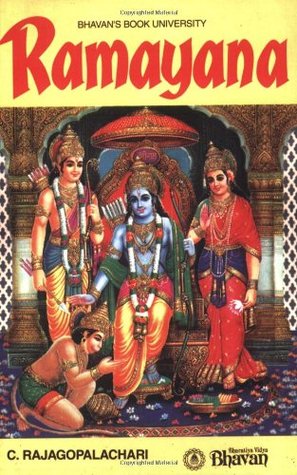
The Ramayana is the combination of the words 'Rama' and 'Ayana' meaning the path of Rama. Rama is presented to us as the ideal man with almost no shades of bad. He is the perfect man who is impossible to find in the present world. The epic openly declares that he is the hero. The Mahabharatha on the other hand is also a combination of two words, 'Maha' and 'Bharatha' meaning Great India or the 'History of great India'. It speaks of the Chandravansh (the dynasty that sprouted out of the moon god, Chandra) a branch of which is the Kuru. Each member is a hero of his own. The great Bharata is a hero. Kuru is a hero. Puru, Nahusha, and Yayati play pivotal roles. Heroism goes to its peak with the ascent of the grand old man of the epic, Bheeshma, who could indeed be a hero. Bheema, the ferocious Pandava could be the hero. Arjuna is a hero as a friend close to Bhagavan Krishna. Yudhisthira (also known as Dharmaputra, Dharmanandana, Dharmaraja or simply, Dharma) could be the hero of the epic as it is his story of winning good over evil. Karna represents the back-trodden sections and as he rises in stature he changes the game. He is a protector of Dharma in one sense. Why, even Duryodhana could be a hero from one point of view. However all fingers point to one person for what we call 'hero'. He unlike, his Treta Yuga counterpart becomes a hero not by being a part of it but himself changing it. He is Krishna Paramatma. What makes them all similar is the fact that they all have their own shades of good and bad. 


Rama and Krishna 

In the Ramayana, Rama is a man, a highly righteous and immensely powerful man, but an incarnation of the almighty. In the Krishna Avatar, the lord consciously knows the past, present, and the future. He is timeless and he is time himself which he means he is superficially man but God himself, that is God born from a human womb.  He knows his divinity and even speaks of it (including in the holy sermon of Bhagavad Gita) while Rama does not. Rama does that much as befits a man's abilities while Krishna's past times are divine. He is magical. 

One quality of Krishna absent in Rama is the rule-breaker. To make the good win, he performs several acts that many-a-time make us question the queer 'Dharma' and as Bheeshma puts it 'Dharma' is subtle and sometimes beyond human perception. In the battle, Krishna is a mere charioteer while Rama is warrior himself. God wielding weapons destroys nature and culture. Rama follows the path paved by the elders while Krishna paves one of his own. Rama is Acharya while Krishna is Guru. According to Krishna you must must perform deeds of honesty, keep your words, and be good. Unless you are good, you have no right to expect good. Only if you are perfectly right on your side you have the right to win. The Pandavas had to win because they were good. If they were to lose, all of humanity would have disgrace. Rule-breaking was necessary. Krishna guided the whole war and through the whole war resulting in Pandava Victory, which Dharmanandana believed was unfair. 
So putting it simply, Rama was the awesome player of the game while Krishna was the game himself. 

One version of the Mahabharatha has an interesting story showing this aspect of the Lord (Source:- Jaya, Devdutt Pattanaik). According to tradition, over the completion of war the charioteer must descend the chariot and then the warrior. After the Kurukshetra War, Arjuna waited for Krishna to descend but over annoyance he got down first, then Krishna did. Immediately after his descent, the chariot burst into flames. Krishna had deliberately stayed, for it was his presence that stopped time from breaking chariot which would have otherwise blown up over the course of war. 


Women in the epics

Both the epics have heroines. Ramayana has Sita, the chaste ideal woman and the Mahabharatha has many including Satyavati, Kunti (Selfishness, Chauvinism), Subhadra and most importantly Draupadi, the one in the spotlight. Sita falls into trouble due to the antagonist Ravana while Draupadi not just falls into trouble but faces infamy and jeopardy due to her brothers-in-law. She is even disrobed in the hall of elders. It is a also due to the weakness of her elder husband. At the same time Draupadi has some bad qualities including her biased love towards one of her husbands and pride. In some respects, her life is full of pricks and is almost never peaceful making the whole of the subcontinent restless at the end. Rama is a  monogamist and Sita is monandrous. In Mahabharatha Krishna is polygamous, Arjuna is polygamous, and even Draupadi is polyandrous. Krishna as we are told is still a Brahmachari because his love towards women is not love but is only a means to satisfy their devotion towards God, as he was a living god.


Some more aspects: 

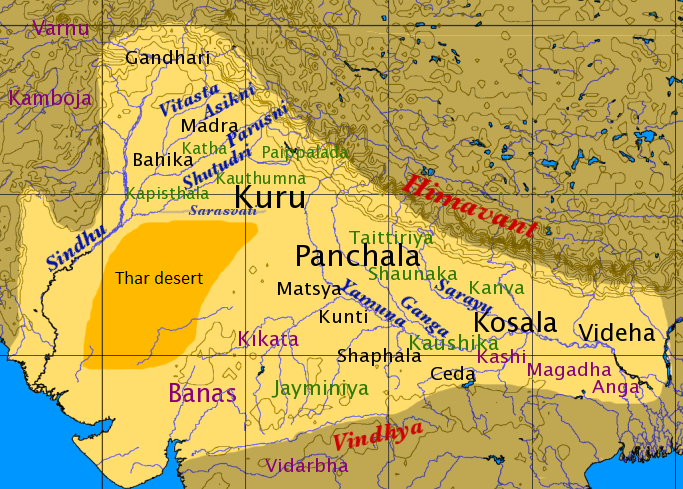
I shall discuss about the villains and the antagonists in a later post. One observation is the orientation and the geography of epics. These affected history. On observation we can see that Lord Rama's 'Ayana' is largely north to south (North-South orientation) while the Mahabharatha was mostly East-West oriented. 
Ramayana 
Mahabharatha

Please comment on this post for further improvement and corrections. Criticism and discussion are open. 

||Paritranaya sadhunam vinashaya cha dushkritam
Dharma sansthapanarthaya sambhavami yuge yuge||


Monday, May 25, 2015

Thus drew the artist


Kiratarjuneeyam 

Karna

Shiva Lingam
Krishna, the cow  herder  

Vasishta 
Eye 


Ravana 


Jatayu Vadha

Krishna the envoy

The little God

Shantanu and Dasaraja


Anjaniputra Hanuman


Hanuman 

Ganesha

Parashurama, the Robin Hood of India


Siddhartha Gautama 


Me as Krishna